
The Propaganda Quiz
Is it? Or isn't it?


The more we’re familiar with propaganda, the less gullible we’ll be — we hope. Problem is we’re so overloaded with people trying to influence our behaviors, whether it’s through advertisements, political campaigns, or peer pressure, it’s nearly impossible to decipher what’s propaganda and what’s not.
As their producer, I’ve asked two of today’s most persuasive critiquistas, CVF and BG, to go head-to-head in a persuade-off to determine which works of art are trying to sneakily disseminate influential messaging. And, in the spirit of unchecked authoritarianism, I’ll be awarding a score to each answer, and selecting a winner — handpicked, really, by me. So, is it propaganda, yes or no?
— Tom Winchester
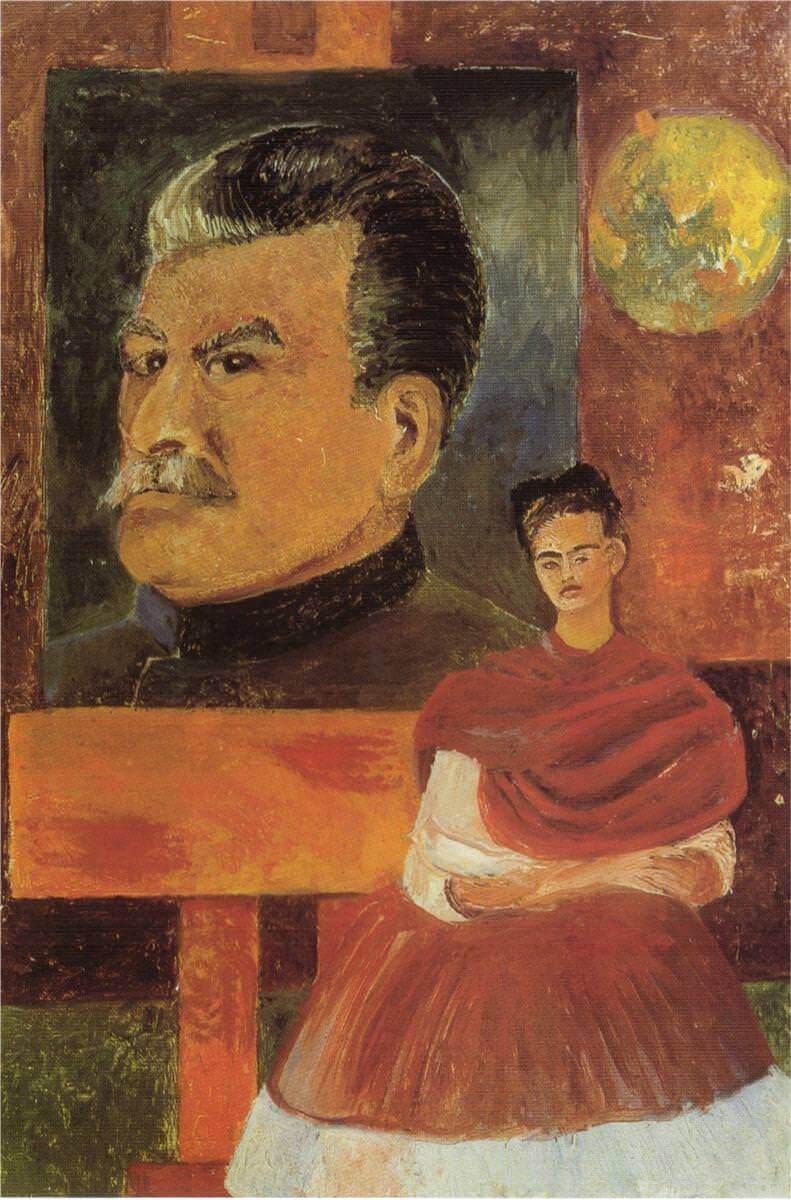
Frida Kahlo, Self-Portrait with Stalin (1954)
Christian Viveros-Fauné: Painted the year Frida Kahlo died, this is surely the artist’s most embarrassing work. Done hack-handedly — she was in a great deal of pain and flying high on morphine and Seconal — her Self-Portrait with Stalin (1954) plumbs the bottomless depths of the groveling a great deal of the global intellectual Left engaged in to curry favor with the so-called “man of steel” (that’s “Stalin” in Russian): the pitiless Soviet genocidaire responsible for the deaths of between 6 and 9 million of his own countryfolk, according to historian Timothy Snyder. Weirdly, Kahlo’s double portrait was painted 14 years after the artist’s affair with Leon Trotsky, Stalin’s bitter rival, whom she harbored in Mexico City before he was murdered inside her own home by Stalin’s agents.
Does Kahlo’s brownnosing painting qualify as propaganda? Let’s just say that I’m with Orwell in firmly believing that “all art is propaganda”; which is to say, that all creative acts implicitly promote a worldview, ideology, or set of values — even, or especially when they purport to be apolitical. Part of what Orwell was after by declaring that every piece of art has a “message” was to promote transparency rather than art-for-art’s-sake or NYT-style objective writing, of which he was highly suspicious. More importantly, Orwell wanted to alert readers and viewers to the evils of propaganda performed or created in the service of genuine political power, i.e., governments of any stripe.
Per Eric Blair in 1940, “All art is propaganda, but not all propaganda is art.” Which brings me back to Kahlo’s canvas. Not sure we’re framing this discussion correctly, Tom, but if you’re asking for a Siskel & Ebert thumbs up or thumbs down on Self-Portrait with Stalin, then I say Kahlo’s painting is not propaganda by a Mexican mile. Though uniquely bad, the painting is simply too strange to qualify as effective or straightforward fake news — probably the best synonym we have today for what Orwell meant by propaganda in his time. Witness Stalin’s ferret-beady peepers as rendered by Kahlo. They suggest the following-eyes drift some joker once pegged as the “Mona Lisa effect.” Creep out.
Blake Gopnik: Well, I’ll start my response to this query, and to this entire exercise, from a million miles up: I think the question “Is it art or propaganda?” is, as the scientists say, “ill posed,” meaning that there can’t be an answer to it, because it’s built on a false premise. “Art” and “propaganda” don’t refer to certain kinds of objects, or to stable categories that objects can be assigned to; instead, they are functions that objects can serve — things we do with and to almost any object you could name. (I’ve explained the “discursive theory” behind this in a big essay published July 1st in the Brooklyn Rail, which Wikipedia tells me was co-founded by our own CVF!)
We can choose (and her contemporaries could choose) to use Kahlo’s portrait as a work of “discursive” art, by digging into its complexities, billing it as critique, analyzing its formal qualities, its place in modernism, its gender implications, etc., etc.
Or they could choose to use that very same object as propaganda, to effect some kind of real political goal: to boost the cult of Stalin, most obviously, but maybe also, more cynically, to procure Soviet funding for Mexico’s communists (whether Stalin lovers or not), or, from the Right wing, to tar Kahlo (quite correctly) as a fellow traveller. In a way, the question should be, “Which function is Kahlo’s self-portrait most likely to serve, with most success?” And — agreeing here with you, Christian — it seems to me that the painting is so ham-fisted, as propaganda, so unlikely to effect any goal or change, that we’re better off enjoying its total weirdness, as art. Could we, for instance, imagine that, at least unconsciously, Kahlo realized that she, too, had come to depend for her success and “power” on a cult of personality, and that it risked turning her into a kind of monster?
Tom Winchester: Come on, y’all. It’s propagandistic af! No points awarded. CVF: 0 BG: 0
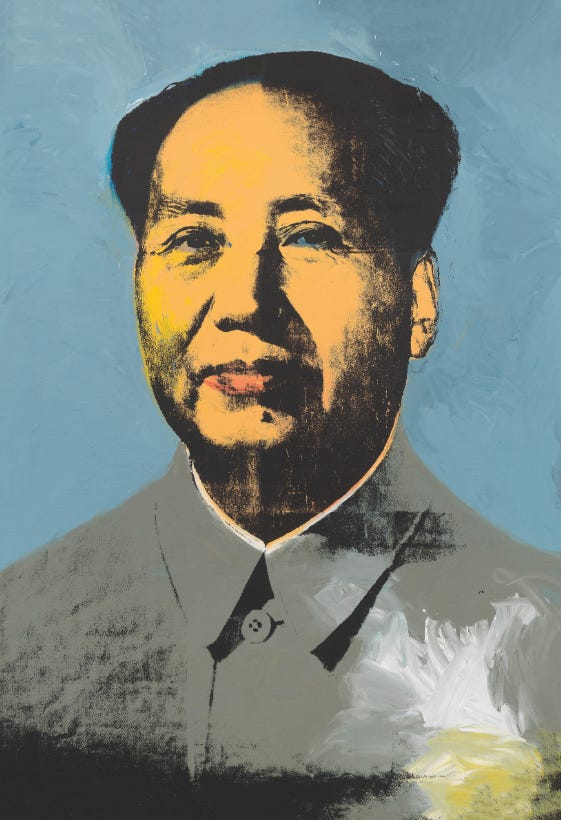
Andy Warhol, Chairman Mao (1972)
CVF: One of a series of giant Mao paintings Warhol began producing in 1972, this parody of avant-garde invention serves as a kind of propaganda for the triumph of market-driven banality as American art. Its tireless and exhausting formula: the star-spangled notion of ubiquity-as-celebrity, backed by the equally Americanized triumph of supply-side aesthetics.
Andy’s Franklin Mint approach to art production, having gone stale after his near-death in 1968, managed a temporary comeback from his frankly narcoleptic forays into “film.” After his Swiss dealer, Bruno Bischofberger, suggested that he paint “the most famous person in the world,” Warhol predictably turned to the day’s headlines — then dominated by Nixon’s historic visit to Communist China. What Bischofberger wanted was a picture of Albert Einstein; what he got was an epochal example of Warhol’s flattening of any and all subject matter into inanity.
Warhol’s giant Mao didn’t just suggest a parallel between state-sponsored communist propaganda and capitalist advertising — the portrait on the cover of the Chairman’s “Little Red Book” got the artist’s usual “Factory” silkscreen treatment — it entirely subsumed one into the other; symbolically, at least. The trick was repeated uncritically 199 times with the very same image. Thus repetition became originality, well-knowness became celebrity, seriality became fungibility and communism — the real thing during the Cultural Revolution — was turned into capitalism thanks to the work of one of the most politically conservative American artists of the twentieth century. U-S-A! U-S-A! U-S-A!
BG: I can’t imagine that anyone could have thought, or could think, that Warhol’s aim in this painting was either to harm or help Mao’s political fortunes. (Although Warhol was happy to promote political causes he believed in: The very year of his Mao, he did a poster for the campaign of the Lefty Democrat George McGovern; it depicted Richard Nixon as a kind of Wicked Witch of the West.)
If Warhol’s Mao is propaganda, you might say it’s rooting for the complexities of an old-fashioned avant-gardism, à la Duchamp, Cage, and Johns, and against a newly surging art market and its love for big, splashy paintings. Those meaningless brushstrokes, at bottom right, say, “You want paint? I’ll give you paint…whether it serves any purpose, or not.” (When his friend Henry Geldzahler complained that Warhol had made a portrait of him that was so photographic, it “left out the art,” Warhol offered to make a new one. “I’ll put the art in this time,” he said, and coughed up a new portrait full of “juicy brush strokes.”)
The one cause Warhol always promoted was the cause of the most profound weirdness. In 1972, a huge, non-political painting of Mao qualified.
TW: Maybe I’m just projecting but both sound like yesses so one point each: CVF: 1 BG: 1.
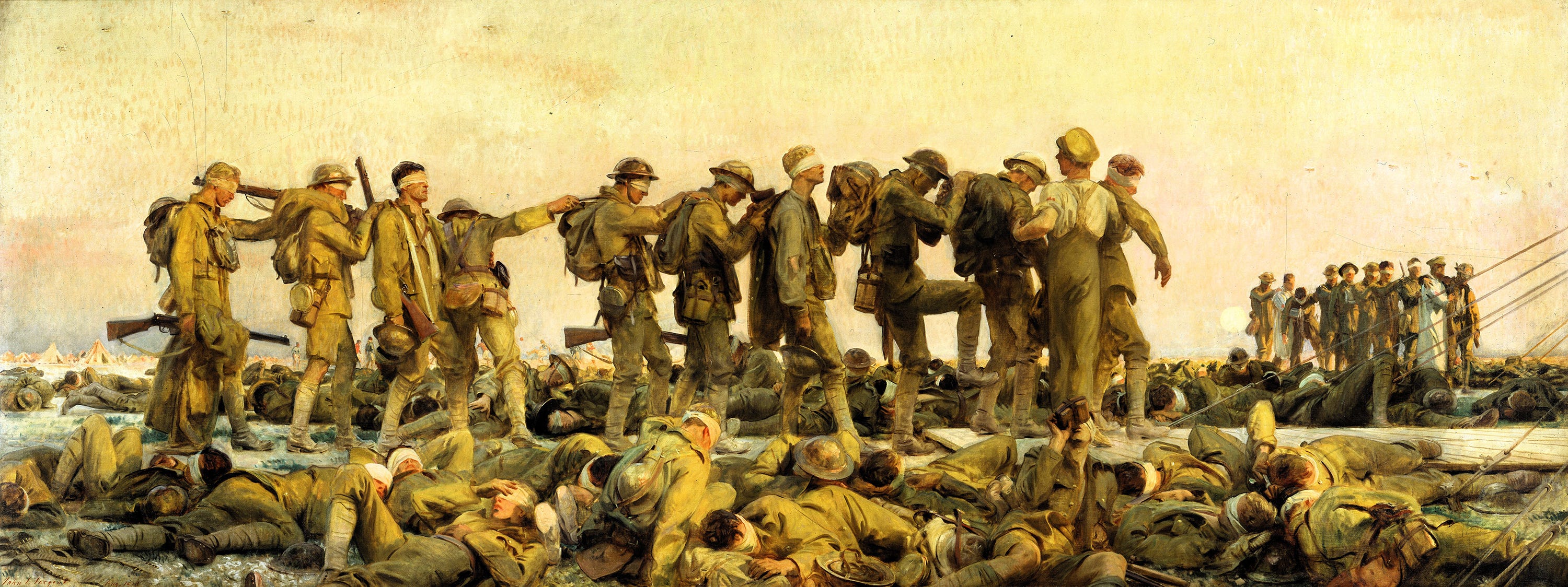
John Singer Sargent, Gassed (1919)
CVF: Commissioned by the British War Memorials Committee, Gassed (1919) is a monumental painting that depicts the aftermath of a mustard gas attack during World War I. The line of blind soldiers being led toward a dressing station was a scene that Sargent apparently witnessed in person on the Arras to Doullens Road in France in August of 1918. He was 62, the same age Francisco Goya was when he purportedly visited a besieged Zaragoza for first-person impressions of the inhuman cruelty that begat The Disasters of War (1810-1820), the latter’s set of 82 antiwar prints. Unlike Goya, Sergeant can’t keep from painting every subject in the grand manner, which makes his renderings of barbarism look bloodless and stagy. Rather than evoke, say, Tintoretto’s Massacre of the Innocents (1582-87), Gassed resembles Norman Rockwell and Thomas Kinkade kitsch, and cannot be considered a great antiwar painting, or even a great painting. Conclusion: Insincere affect in pursuit of high-toned feeling by itself does not propaganda make. Want a contemporary analog for Sargent’s Gassed, Tom? I’ve got two words for you: Anselm Kiefer.
BG: Here it comes again, Tom, that Gopnikian word you’ve been waiting for: “Ostension.” Sometimes, propaganda works best by simply “ostending toward” — simply pointing out — a state in the world to be praised or decried. And if that’s the goal, Christian’s “great painting,” full of rich, novel complexity, is just what you don’t want. A style that’s stale and old fashioned can step out of the way, to let content speak for itself — to let a picture simply ostend, transparently, toward the world. Sargent’s painting spoke to its conservative British audience about something important, in a language they could understand — understand so instantly, in fact, that they didn’t notice that it came with any kind of an “accent” at all. Whereas a “better” painter might have got in the way of this important subject. I guess I’m arguing that Sargent is more like an Allan Sekula, with his photo documents of world labor, than he is like Kiefer, whose great flaw is an irredeemable artiness.
TW: I mean, it was commissioned by arguably the most propagandaful government in history so what are we doin’ here y’all. No points awarded: CVF: 1 BG: 1
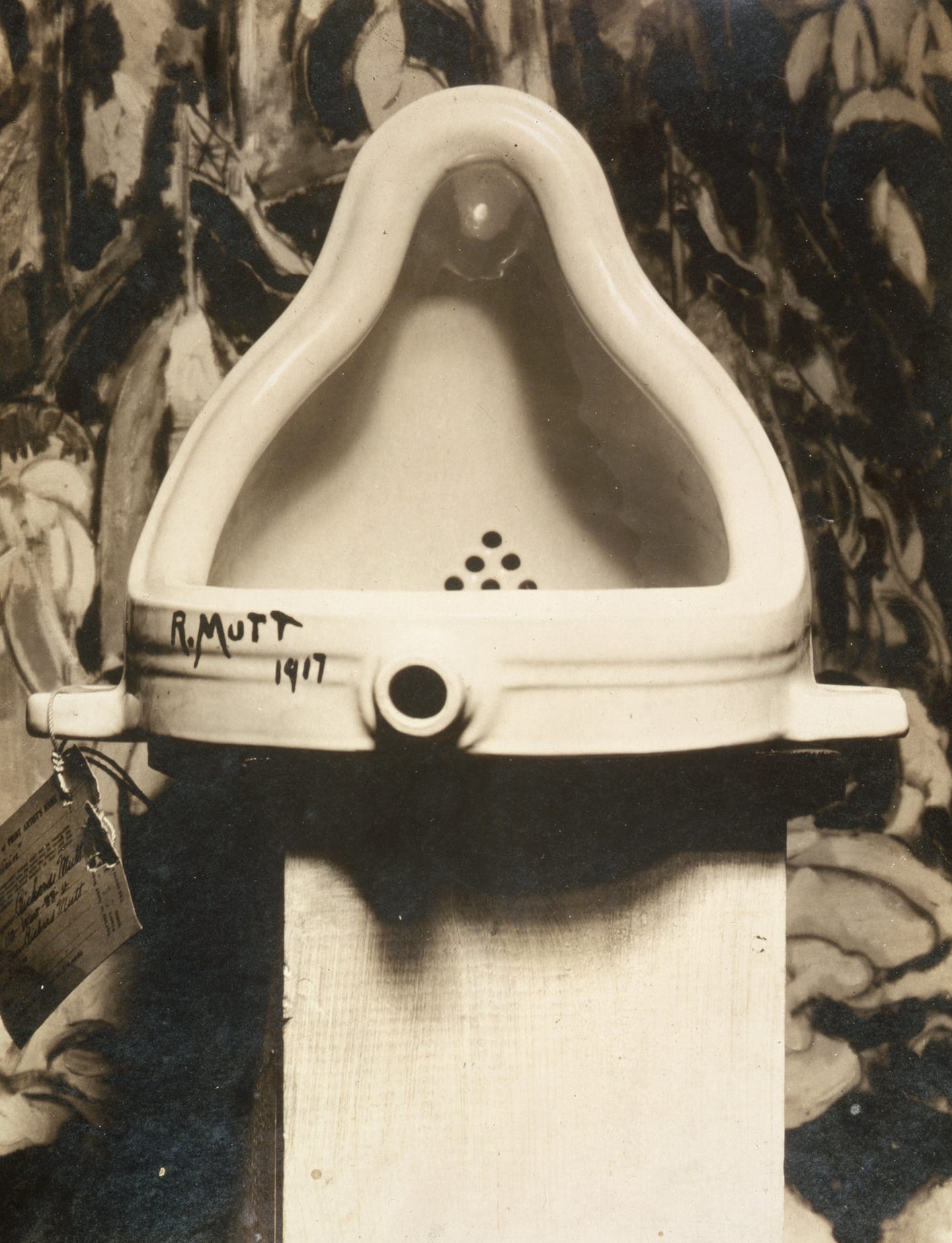
Alfred Stieglitz, Fountain (1917)
BG: Propaganda — for a good or bad cause — should be able to deliver some simple message. I’ve spent the last year and more digging deep into Fountain, and have yet to find any one thing it means or has meant. It’s been the most amazingly fertile object, generating all kinds of readings, from praise for its industrial beauty, to anger at its iconoclasm, to pleasure in its sheer (purported) absurdism, to wonder at its conceptual rigor.
And I guess that the one thing propaganda should do is make some kind of splash, and get noticed — which Fountain singularly failed to do. There was no “scandal” at all: Fountain got the barest dribbles of press (compare that to wall-to-wall coverage of Duchamp’s Nude Descending a Staircase) and Stieglitz’s single image of it went out to at most a couple of hundred readers who ever saw The Blind Man. No one even noticed that painting by Hartley in the background until something like seven decades later. (Tom, with this image, you gave me an unfair advantage over Christian, at least when it comes to the facts-of-the-matter: I somehow doubt he’s read the hundreds of pages on Fountain that I have — lucky guy.)
CVF: This picture is propaganda of the most brazen sort. The only surviving record of Marcel Duchamp’s original readymade, Stieglitz’s photograph of Fountain (1917) restaged the succès de scandale produced by the French artist’s submitting a signed urinal to the Society of Independent Artists’ exhibition in New York. Despite the society’s promise to accept any artwork for a fee, it rejected Fountain, prompting Duchamp to resign in protest. Duchamp then took the urinal to Alfred Stieglitz’s 291 gallery in New York. Not one to miss a golden PR opportunity, Stieglitz photographed Duchamp’s pissoir against Marsden Hartley’s painting The Warriors.
A few months later, Stieglitz’s photo debuted inside the pages of The Blind Man, a Dada-inspired art magazine. The published photo set into motion a conceptual art campaign as concerted as anything dreamed up by Donald Trump’s Department of War; one that promoted “idea art” among hordes of avant-gardists, and elevated a simple plumbing fixture into an icon of 20th-century art. Should we consider Stieglitz’s black-and-white photo propaganda? Is the Pope taking a leak in the woods Catholic?
TW: Willikers! I’m torn! Such persuasive arguments from both parties! Touché, Strict Crits. One point each: CVF: 2 BG: 2
Well, there you have it. Another enlightening debate on an important art-related issue. Does such an exercise answer all of our questions on that ever-so-elusive genre called propaganda? No. Have the Strict Crits unearthed everything there is to consider about propaganda and how it’s defined? Not even close. Have we now spun into an endless cycle of suspecting that literally everything we see is somehow being used against us? Definitely. (‘Skinda the point.)
Alas, The Propaganda Quiz ends in a draw. I guess that means we’ll hafta do this again soon so we can determine a clear winner. Luckily, there’re lots of propaganda in the history of art to argue over.
A fun read, even if neither party seemed to think that the art/propaganda distinction holds water. (Me neither!) Unless we're going to dismiss effectively all of Western fine art made between the 16th and 18th centuries, when "Art" ceased to function magically or ritualistically and became the purview of social and religious elites, concerned with presenting themselves and their regimes in a positive light, it's obvious that works with propagandistic (rhetorical, persuasive) intent can be great works of art.
What's interesting about the framing of the question is that the dialogue arrives at a more or less explicit definition of propaganda (ideologically motivated, rhetorical, made with a specific audience in mind...), but doesn't even begin to imply a definition for art or any criteria by which to judge whether or not something is, indeed, a work of art (a much thornier queston that Blake dealt with admirably in his recent essay in the Brooklyn Rail).
My take: None of the works presented are propaganda OR art! Two mediocre paintings, one uninteresting print, and one photograph of an art historically-relevant found object (though, it's worth asking whether the artwork presented as Duchamp's is indeed Fountain, the found object, which was lost and, I'm inclined to say, therefore can't be judged as an artwork since it can't be experienced in person, or whether it's a photo by Steiglitz, in which case I'd be more inclined to call it (the photograph) art).
A minor point of correction: Trotsky was not murdered in Kahlo's home, as CVF claims. He was rather murdered in his own home.
Now for a point of contention: Warhol's own intention or lack thereof in remaking the image of Mao cannot be the defining criterion for deciding whether the work is propaganda. This seems to me the least interesting and important part of the problem.